What is a forward deployed engineer (FDE)?
What a forward deployed engineer does, how the role differs from software and solutions engineers, and how startups get one.
A forward deployed engineer (FDE) is a software engineer who works inside the team or customer environment where the product is actually used, building and shipping code there instead of from a separate product or agency team. A typical software engineer goes deep on one part of a product. An FDE goes deep on one team's problems, and touches whatever part of the stack those problems need.
Palantir popularised the title, and OpenAI, Anthropic and a growing number of YC-backed AI startups now hire for it. For founders, the term has come to cover two different jobs, and knowing which one you need is the first hiring decision.
TL;DR
- An FDE writes production code inside the environment where it gets used: a customer's stack, or your own startup's team.
- Vendor-side FDEs work for a software company and embed with its customers. Embedded FDEs come from a partner like Lyra and join your team.
- Hiring a senior engineer in-house takes 4 to 12 months. An embedded FDE can start in days.
The two kinds of forward deployed engineer
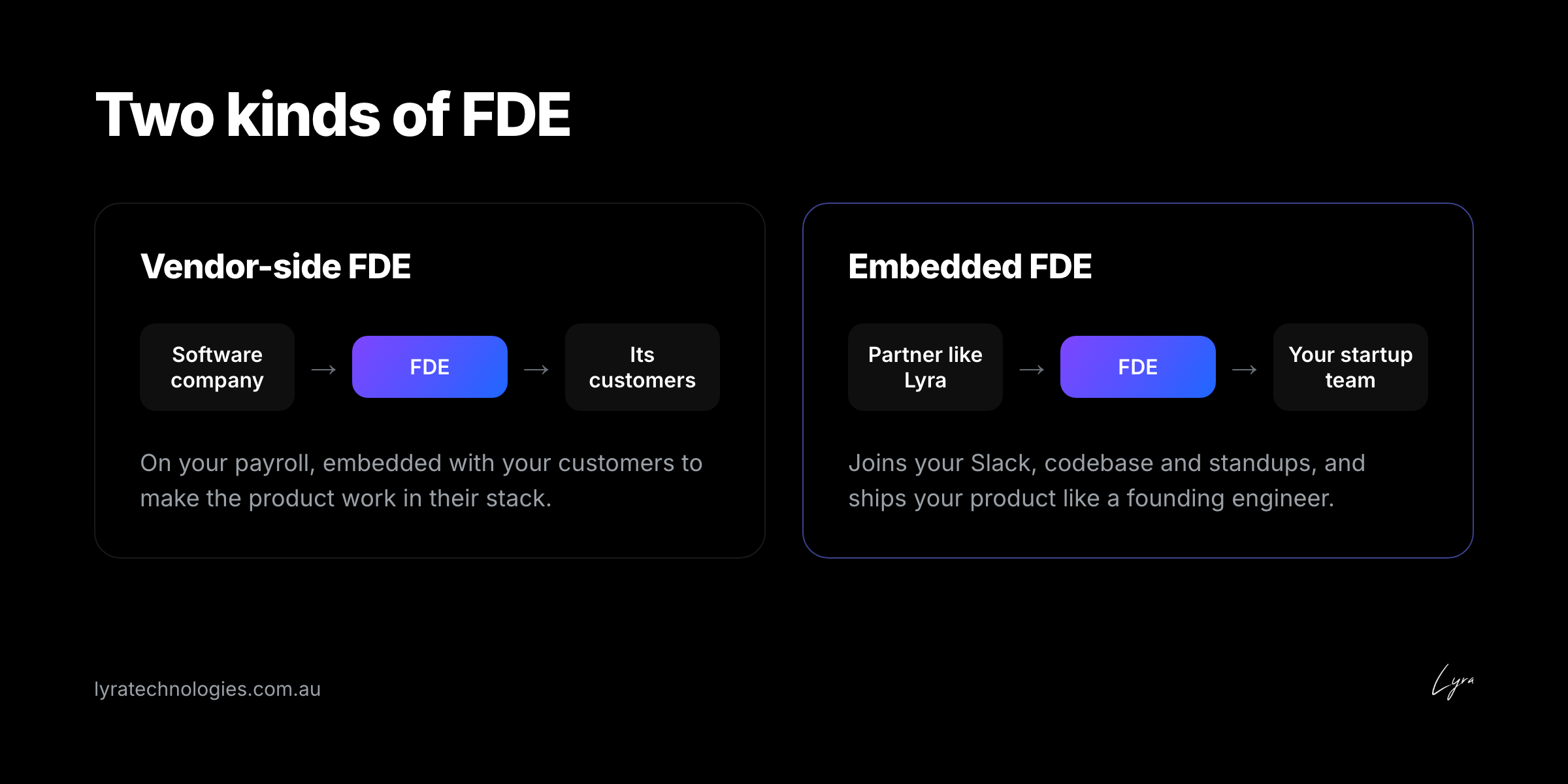
If you sell an AI product to enterprises and every deployment needs custom data work, you need vendor-side FDEs on your payroll. If you just raised and need product shipped while you recruit, you need an embedded FDE.
What does a forward deployed engineer do?
An FDE's week covers the whole arc of a piece of work, which is the part a ticket-taking contractor never sees:
- Discovery. They sit close enough to the users to find the real problem, often before anyone writes it down.
- Building. They write production code across the stack: frontend, backend, data pipelines, infrastructure.
- Shipping. They deploy, watch it break under real usage and fix the edge cases.
- Handover. They leave the system documented so the in-house team can own it.
Some examples from Lyra engineers embedded in startups:
- At Thunder Compute (YC, GPU cloud), one engineer owned the frontend, a new Go CLI, Stripe billing, fraud prevention and CI/CD, through the company's $13M Series A. Read the case study
- At Andera, an engineer turned a 40MB audit workbook into structured data an AI agent could read, evaluate and improve against, through a $37M raise.
- At Lucent, an engineer shipped API v1, webhooks and backend refactors in about six weeks, then handed off cleanly when Lucent hired in-house.
- At Hobbes, embedded engineers built verifier agents and self-healing repair loops, taking an MVP to a GTM-ready product and a $6M seed.
FDE vs software engineer vs solutions engineer
The test that separates them: ask who gets paged when it breaks in production. For an FDE, it is them.
How a startup gets forward deployed engineering capacity
Agencies take a brief and come back with work for you to review. Freelance marketplaces give you individuals you have to manage yourself. An embedded FDE joins your team and works like the founding engineer you have not hired yet.
When to bring in an FDE, and when not to
Bring one in when:
- You just raised and the roadmap is ahead of your engineering headcount.
- Your senior engineers spend most of their time on execution that a strong engineer could own, and the architecture calls get squeezed.
- You are a non-technical founder who needs an engineering team, not a vendor.
- You are hiring in-house and need someone shipping in the meantime.
Hire full-time instead when:
- You need a long-term technical leader who sets direction and holds equity.
- The role is mostly people management.
- The work is a small fixed-scope task a freelancer could finish in a week.
What to look for in a forward deployed engineer
- Ships without hand-holding. Can pick up an unfamiliar codebase, get context and ship in the first week.
- Product judgment. Suggests the better feature, not just the requested one.
- Breadth across the stack. Frontend, backend, data and infrastructure, since FDE work rarely stays in one layer.
- Written communication. Clear daily updates, because the person they report to is usually a busy founder.
- AI-native workflow. Uses tools like Claude Code, Cursor or Codex as part of how they build.
How Lyra's forward deployed engineers work

Every engineer Lyra places is an FDE. A few specifics:
- Vetting. Fewer than 3% of applicants make it through, and every engineer is trained before touching a client codebase.
- One client at a time. Lyra engineers are full-time Lyra employees deployed full-time to one team, so they work like a founding engineer, not a contractor watching the clock.
- AI-native. Every engineer builds with Claude Code, Cursor or Codex.
- Australia-based, US-facing. Engineers are in Sydney and across Australia. The Sydney morning overlaps the US West Coast afternoon, and work done overnight is ready for review when US teams start their day.
- Stack. Mostly Next.js, TypeScript and Python, plus React, Node, Go and Rust. Lyra matches on stack before pitching an engineer.
- Flexible. Clients have scaled between one and ten engineers on the same engagement.
- Zero-risk start. If you are not happy with the engineer's work in the first week, Lyra refunds it in full.
Lyra has worked with 100+ startups, including 15+ YC companies, Paraform, ReadMe and Chakra. Read the case studies or book a call.
Frequently asked questions